What Texas riders need to know about e-bike classes, electric dirt bike registration, and where each vehicle can legally be ridden in 2026
Texas has some of the best riding country in the US — wide open highways, rugged Hill Country trails, and long ranch roads that feel made for two wheels. But before you take your e-bike or electric dirt bike onto public roads, you need one thing sorted first: is your vehicle actually street legal in this state?
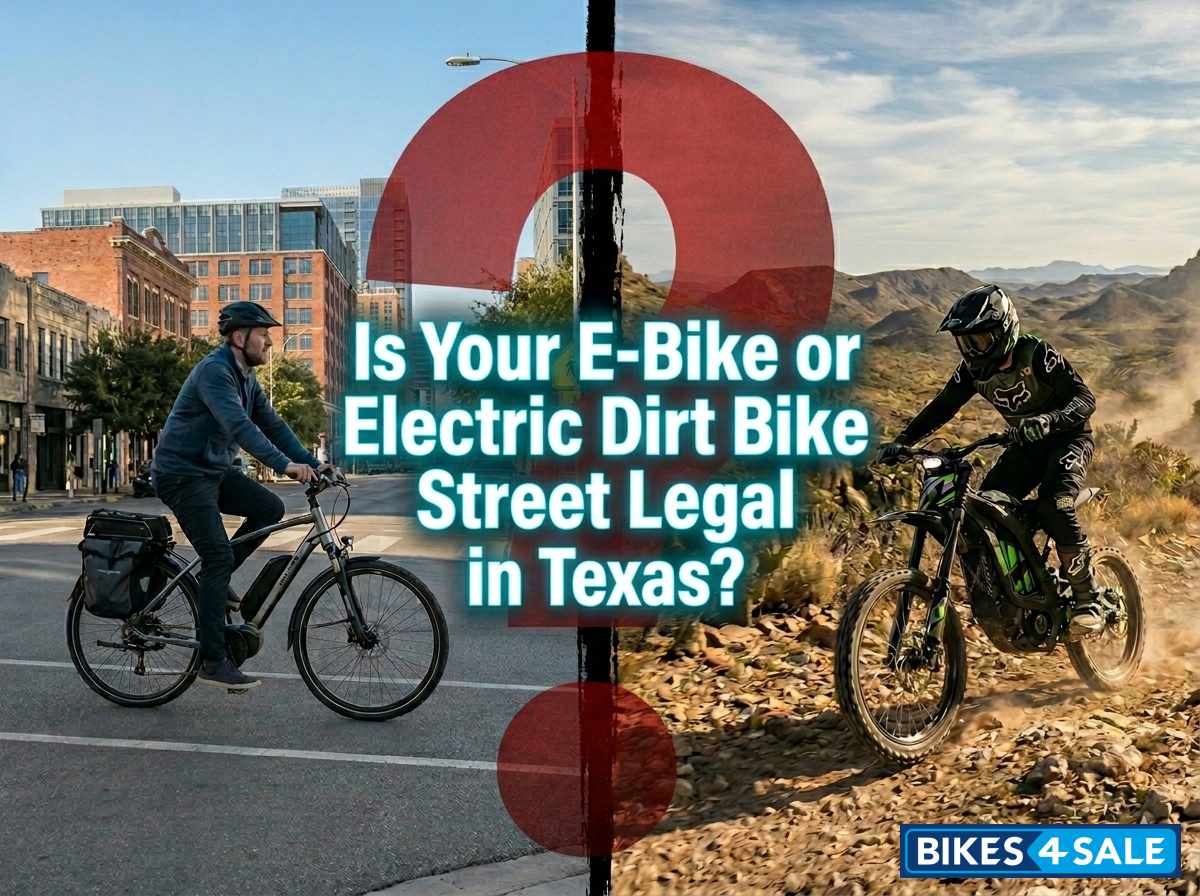
The answer is not the same for every rider. Texas draws a clear legal line between street-legal electric bicycles, electric motorcycles, and off-road electric vehicles. Get it wrong and you are looking at fines, impoundment, or a registration rejection you did not see coming.
This guide covers every category, in plain terms, so you know exactly where your bike stands.
It depends entirely on what you are riding and what it is capable of. A standard pedal-assist commuter e-bike from Trek or Aventon? Street legal with zero paperwork. A Sur-Ron Light Bee X you bought for trail riding? Not street legal out of the box, regardless of how much you paid for it.
Texas law does not care whether a vehicle runs on electricity or gasoline. It cares about motor size, top speed, whether the vehicle has pedals, and whether it meets the safety equipment requirements for whatever class of vehicle it actually is. That distinction decides everything.
Texas follows the three-class e-bike system used across most US states. The classification is based on motor power, top assisted speed, and how that power is delivered to the rider.
To qualify as a street-legal electric bicycle under the Texas Transportation Code, a bike needs three things: fully operable pedals, a motor below 750 watts, and a top motor-assisted speed of 28 mph or under. Hit all three and you need no license, no registration, and no insurance. Texas treats it the same as a regular bicycle on public roads.
Class 3 riders get one additional wrinkle. Even though state law allows Class 3 bikes on public roads, individual Texas cities can restrict them on shared-use paths, trails, and pedestrian corridors. Austin and Dallas both have local rules that differ from the statewide standard. Before you take a Class 3 bike onto a trail network, check your city's ordinance first.
Looking for a new street-legal e-bike and want to compare motor specs before buying? The Bikes4Sale comparison tool lets you check wattage, speed, and range across hundreds of models side by side.
This is where riders regularly get caught off guard, especially with high-powered bikes that still look like regular bicycles.
If your electric bike has a motor above 750 watts, pushes past 28 mph under power, or lacks functional pedals, it no longer qualifies as an electric bicycle under Texas law. At that point it gets reclassified as a moped, motorcycle, or motor-driven cycle depending on its specs — and each of those categories brings its own registration, licensing, and insurance requirements.
A lot of performance e-bikes sold online sit in this grey zone. The frame looks like a bicycle, the price is close to a bicycle, but the motor is 1,000W or 1,500W — which puts it firmly outside the e-bike definition. Texas law enforcement does not care about the frame shape. They care about what the motor can do.
If you want to browse verified street-legal options, the Bikes4Sale new bikes section covers electric bikes, scooters, and motorcycles from brands including Zero, Kawasaki, Honda, and more — all with full spec listings.
Electric dirt bikes and street-legal e-bikes are not in the same legal conversation in Texas. Not even close.
Bikes like the Sur-Ron Light Bee X, Talaria Sting MX5, and Segway X260 are off-road electric motorcycles. They are not electric bicycles. They typically have no real pedals, motors well above 750 watts, and they are designed from the ground up for trail and off-road performance — not street commuting. Texas law treats them accordingly.
An electric dirt bike ridden on a public road in Texas without proper registration and a motorcycle license is treated as an unlicensed motor vehicle. The fact that it runs on a battery changes nothing legally. The question Texas law asks is whether the vehicle meets the requirements for road use — and most electric dirt bikes do not, straight from the factory.
They are typically missing: DOT-compliant lighting, functional turn signals, a rear-view mirror, a working horn, and DOT-rated tires. All of those are required to register any motorcycle for road use in Texas.
Yes, but it is not a quick job. To register an electric dirt bike as a motorcycle with TxDMV, you generally need to:
• Install DOT-compliant front and rear lights
• Add working turn signals, front and rear
• Fit at least one rear-view mirror
• Install a functional horn
• Switch to DOT-rated tires
• Pass a Texas vehicle safety inspection
• Obtain a Texas title and license plate
• Hold a valid Class M motorcycle license
Beyond the hardware, there is a VIN problem. Many imported electric dirt bikes — including several popular Chinese-manufactured models — do not carry a US-recognized VIN. Without one, the vehicle cannot be titled in Texas. Some owners work around this through specialty registration services or out-of-state titling, but it is a significant hurdle and worth researching before you buy.
The Sur-Ron Light Bee X is the most common example people ask about. The standard 8kW model is not NHTSA-certified for US roads. Sur-Ron makes a road-legal variant called the L1E for European markets, but European road compliance does not carry over to Texas registration. If you own a Sur-Ron and want to ride it on public roads, contact TxDMV directly or speak with a Texas vehicle registration attorney before you assume it is legal.
Not being street legal does not mean you are stuck in the garage. Texas has real options for off-road electric vehicle riders:
• Private property, with the landowner's permission
• Designated OHV (off-highway vehicle) parks managed by Texas Parks and Wildlife
• Closed motocross tracks and private riding facilities
• Some state recreation areas that allow OHV use (verify trail rules per park before going)
Texas off-road culture runs deep, and the OHV trail network across the state is genuinely well-developed. Many riders treat their electric dirt bike as a dedicated trail machine and pair it with a separate street-legal e-bike or motorcycle for road use — keeping each vehicle in the environment it was built for.
Texas has a massive community of off-road drivers alongside its riding culture — overlanders, rock crawlers, lifted 4x4 trucks, and off-road SUV builds that tackle the same kind of terrain as electric dirt bikes. The legal principle governing all of them is the same.
A purpose-built off-road SUV or 4x4 truck with a full roll cage, no mirrors, and off-road-only tires is not street legal either. It does not matter that it costs $60,000 or that it runs perfectly. Without proper lighting, a VIN, registration, and road-legal equipment, it cannot go on public roads in Texas. Off-road truck and SUV owners deal with this every day — they either build a street-legal rig or they trailer it to the trail.
Electric dirt bike riders are in the exact same position. The machine is not the problem. The legal status of that machine on public roads is.
This matters practically for anyone who wants to ride from home to a trail, or from one trail access point to another on public roads. If your electric dirt bike is not registered as a motorcycle, that short stretch of road is illegal riding in Texas, even if it is only a quarter mile.
If you want to browse used street-legal motorcycles in the US while you sort out your off-road setup, used bikes for sale across the United States covers everything from cruisers to commuters with verified seller listings.
Texas keeps it relatively simple for standard e-bikes: Class 1, 2, and 3 bikes with motors under 750 watts and speeds under 28 mph are street legal without any paperwork. But anything beyond those limits — high-powered e-bikes, electric dirt bikes, or off-road electric motorcycles — falls into motor vehicle territory and needs to be treated that way.
Before you buy, check the motor wattage and top speed. Before you ride on public roads, know which class your vehicle actually belongs to.
"Texas transportation laws can change. Always confirm current requirements with TxDMV or a licensed Texas attorney before making purchasing or registration decisions."
The answer is not the same for every rider. Texas draws a clear legal line between street-legal electric bicycles, electric motorcycles, and off-road electric vehicles. Get it wrong and you are looking at fines, impoundment, or a registration rejection you did not see coming.
This guide covers every category, in plain terms, so you know exactly where your bike stands.
Is Your E-Bike or Electric Dirt Bike Street Legal in Texas?
It depends entirely on what you are riding and what it is capable of. A standard pedal-assist commuter e-bike from Trek or Aventon? Street legal with zero paperwork. A Sur-Ron Light Bee X you bought for trail riding? Not street legal out of the box, regardless of how much you paid for it.
Texas law does not care whether a vehicle runs on electricity or gasoline. It cares about motor size, top speed, whether the vehicle has pedals, and whether it meets the safety equipment requirements for whatever class of vehicle it actually is. That distinction decides everything.
How Texas Classifies Electric Bikes
Texas follows the three-class e-bike system used across most US states. The classification is based on motor power, top assisted speed, and how that power is delivered to the rider.
| Class | How It Works | Top Assisted Speed | Street Legal? |
|---|---|---|---|
| Class 1 | Pedal-assist only, no throttle | 20 mph | Yes |
| Class 2 | Throttle-assisted, pedals present | 20 mph | Yes |
| Class 3 | Pedal-assist only, higher speed | 28 mph | Yes, with some restrictions |
To qualify as a street-legal electric bicycle under the Texas Transportation Code, a bike needs three things: fully operable pedals, a motor below 750 watts, and a top motor-assisted speed of 28 mph or under. Hit all three and you need no license, no registration, and no insurance. Texas treats it the same as a regular bicycle on public roads.
Class 3 riders get one additional wrinkle. Even though state law allows Class 3 bikes on public roads, individual Texas cities can restrict them on shared-use paths, trails, and pedestrian corridors. Austin and Dallas both have local rules that differ from the statewide standard. Before you take a Class 3 bike onto a trail network, check your city's ordinance first.
Looking for a new street-legal e-bike and want to compare motor specs before buying? The Bikes4Sale comparison tool lets you check wattage, speed, and range across hundreds of models side by side.
What If Your E-Bike Exceeds Those Limits?
This is where riders regularly get caught off guard, especially with high-powered bikes that still look like regular bicycles.
If your electric bike has a motor above 750 watts, pushes past 28 mph under power, or lacks functional pedals, it no longer qualifies as an electric bicycle under Texas law. At that point it gets reclassified as a moped, motorcycle, or motor-driven cycle depending on its specs — and each of those categories brings its own registration, licensing, and insurance requirements.
A lot of performance e-bikes sold online sit in this grey zone. The frame looks like a bicycle, the price is close to a bicycle, but the motor is 1,000W or 1,500W — which puts it firmly outside the e-bike definition. Texas law enforcement does not care about the frame shape. They care about what the motor can do.
If you want to browse verified street-legal options, the Bikes4Sale new bikes section covers electric bikes, scooters, and motorcycles from brands including Zero, Kawasaki, Honda, and more — all with full spec listings.
Electric Dirt Bikes: A Completely Different Category
Electric dirt bikes and street-legal e-bikes are not in the same legal conversation in Texas. Not even close.
Bikes like the Sur-Ron Light Bee X, Talaria Sting MX5, and Segway X260 are off-road electric motorcycles. They are not electric bicycles. They typically have no real pedals, motors well above 750 watts, and they are designed from the ground up for trail and off-road performance — not street commuting. Texas law treats them accordingly.
An electric dirt bike ridden on a public road in Texas without proper registration and a motorcycle license is treated as an unlicensed motor vehicle. The fact that it runs on a battery changes nothing legally. The question Texas law asks is whether the vehicle meets the requirements for road use — and most electric dirt bikes do not, straight from the factory.
They are typically missing: DOT-compliant lighting, functional turn signals, a rear-view mirror, a working horn, and DOT-rated tires. All of those are required to register any motorcycle for road use in Texas.
Can You Make an Electric Dirt Bike Street Legal in Texas?
Yes, but it is not a quick job. To register an electric dirt bike as a motorcycle with TxDMV, you generally need to:
• Install DOT-compliant front and rear lights
• Add working turn signals, front and rear
• Fit at least one rear-view mirror
• Install a functional horn
• Switch to DOT-rated tires
• Pass a Texas vehicle safety inspection
• Obtain a Texas title and license plate
• Hold a valid Class M motorcycle license
Beyond the hardware, there is a VIN problem. Many imported electric dirt bikes — including several popular Chinese-manufactured models — do not carry a US-recognized VIN. Without one, the vehicle cannot be titled in Texas. Some owners work around this through specialty registration services or out-of-state titling, but it is a significant hurdle and worth researching before you buy.
The Sur-Ron Light Bee X is the most common example people ask about. The standard 8kW model is not NHTSA-certified for US roads. Sur-Ron makes a road-legal variant called the L1E for European markets, but European road compliance does not carry over to Texas registration. If you own a Sur-Ron and want to ride it on public roads, contact TxDMV directly or speak with a Texas vehicle registration attorney before you assume it is legal.
Where Can You Legally Ride Off-Road Electric Vehicles in Texas?
Not being street legal does not mean you are stuck in the garage. Texas has real options for off-road electric vehicle riders:
• Private property, with the landowner's permission
• Designated OHV (off-highway vehicle) parks managed by Texas Parks and Wildlife
• Closed motocross tracks and private riding facilities
• Some state recreation areas that allow OHV use (verify trail rules per park before going)
Texas off-road culture runs deep, and the OHV trail network across the state is genuinely well-developed. Many riders treat their electric dirt bike as a dedicated trail machine and pair it with a separate street-legal e-bike or motorcycle for road use — keeping each vehicle in the environment it was built for.
Texas E-Bike and Electric Vehicle Laws: Quick Reference
| Question | Answer |
|---|---|
| License required for e-bike? | No, for Class 1, 2, and 3 bikes. |
| Registration required? | No, for qualifying e-bikes. |
| Insurance required? | No, for qualifying e-bikes. |
| Minimum age to ride? | 15 years old. |
| Helmet required? | Strongly recommended; required under 18 in many cities. |
| Night riding requirements | Front lamp visible from 500 ft and a rear reflector are required. |
| Class 3 on trails? | Restricted in some parks and city corridors. |
| Electric dirt bike on public roads? | Only if registered as a motorcycle with full safety equipment. |
| Sur-Ron Light Bee X street legal in Texas? | No, not out of the box. |
The Off-Road Vehicle Parallel: E-Bikes, Electric Dirt Bikes, and 4x4 SUVs
Texas has a massive community of off-road drivers alongside its riding culture — overlanders, rock crawlers, lifted 4x4 trucks, and off-road SUV builds that tackle the same kind of terrain as electric dirt bikes. The legal principle governing all of them is the same.
A purpose-built off-road SUV or 4x4 truck with a full roll cage, no mirrors, and off-road-only tires is not street legal either. It does not matter that it costs $60,000 or that it runs perfectly. Without proper lighting, a VIN, registration, and road-legal equipment, it cannot go on public roads in Texas. Off-road truck and SUV owners deal with this every day — they either build a street-legal rig or they trailer it to the trail.
Electric dirt bike riders are in the exact same position. The machine is not the problem. The legal status of that machine on public roads is.
This matters practically for anyone who wants to ride from home to a trail, or from one trail access point to another on public roads. If your electric dirt bike is not registered as a motorcycle, that short stretch of road is illegal riding in Texas, even if it is only a quarter mile.
If you want to browse used street-legal motorcycles in the US while you sort out your off-road setup, used bikes for sale across the United States covers everything from cruisers to commuters with verified seller listings.
Frequently Asked Questions
| 1. Is Your E-Bike or Electric Dirt Bike Street Legal in Texas? |
| It depends on the bike. Class 1, 2, and 3 electric bicycles with motors under 750 watts and a top assisted speed of 28 mph or less are street legal in Texas with no license or registration needed. Electric dirt bikes are generally not street legal without significant modifications, registration as a motorcycle, and a Class M license. |
| 2. Do I need a motorcycle license to ride an e-bike in Texas? |
| No. As long as your bike qualifies as a Class 1, 2, or 3 electric bicycle under Texas law, no motorcycle license, driver's license, or special permit is required. |
| 3. Is a 1,000W e-bike street legal in Texas? |
| Not under the electric bicycle definition. A motor above 750 watts disqualifies it as an e-bike. Depending on its top speed and design, it may need to be registered as a moped or motorcycle, which requires a license plate and appropriate license. |
| 4. Can I ride my Sur-Ron Light Bee X on Texas streets? |
| Not legally, out of the box. The standard Sur-Ron Light Bee X lacks the DOT lighting, turn signals, mirrors, horn, and NHTSA certification required for road use in Texas. A street-legal conversion is possible in theory, but it is complex and involves resolving the VIN and registration hurdles with TxDMV. |
| 5. Where can I legally ride an electric dirt bike in Texas? |
| On designated OHV trails, private land with permission, and closed riding facilities. Public roads require motorcycle registration, full safety equipment, and a Class M license. |
| 6. What happens if I ride an unregistered electric dirt bike on Texas roads? |
| Texas law enforcement treats it the same as an unregistered gas motorcycle. You can face fines for operating without registration, riding without the proper license class, and risk vehicle impoundment. |
| 7. Do Texas e-bike laws cover electric scooters? |
| Not under the same classification. Sit-down electric mopeds and scooters that exceed e-bike limits generally need registration, insurance, and a moped or motorcycle license depending on their top speed. |
Texas keeps it relatively simple for standard e-bikes: Class 1, 2, and 3 bikes with motors under 750 watts and speeds under 28 mph are street legal without any paperwork. But anything beyond those limits — high-powered e-bikes, electric dirt bikes, or off-road electric motorcycles — falls into motor vehicle territory and needs to be treated that way.
Before you buy, check the motor wattage and top speed. Before you ride on public roads, know which class your vehicle actually belongs to.
"Texas transportation laws can change. Always confirm current requirements with TxDMV or a licensed Texas attorney before making purchasing or registration decisions."

 The 7 Best Electric Mountain Bikes in the US (2026)
 8 Best Electric Mopeds Under $1,000 in the USA (2026)
 The 10 Most Expensive Motorcycles Ever Made
 Top-Rated Gas Scooter Brands in the US (2026)
 10 Best Electric Commuter Motorcycles in the USA (2026)
 Top 10 Best 50cc Scooters in the USA (2026)
 Top 7 Women's Road Bikes for USA 2026 - Best Picks
 Top 5 125cc Motorcycles for USA 2026 - Best Beginner Bikes